After being dropped off at the port entrnce by Marcelo I made my way through immigration to the quayside and down towards the Plancius which was to be my home for the next few weeks. My luggage had already been taken from the drop off point to my cabin and I joined an excited group of 90 passengers waiting to be checked in and embark on our voyage. All the Oceanwide Expedition guides were waiting to greet us as we came up the gangway. It was my first meeting with Regis Perdriat, a French birder and seabird expert, who, on spotting me with camera and binoculars slung around my neck, asked whether I was a birder!
After being shown to my cabin I unpacked before going into the lounge area where we were introduced ot the guides and crew who undertook compulsory lifeboat drill with us followed by a briefing as to our proposed voyage. Expedition leader, Eduardo, said he'd been discussing the weather forecast with the captain, Ernesto, and it was pretty shocking. As a result plan B was already in operation and instead of taking a clockwise voyage visiting The Falklands and then South Georgia first we were doing the journey in reverse and heading straight down to the Antarctic Peninsula! So began our introduction to Edu's plans A,B & C.........
A quick dinner on board in the superb restaurant and I was up on the bridge deck wildlife spotting as we sailed down the Beagle Channel as darkness fell. Within a very short space of time I'd seen Magellanic Penguin & Diving Petrel, Black-browed Albatross and Fin Whale!
Over the next few days I spent most of my time on the bridge. I was surprisingly the only 'serious' birder on board and was generally on my own. I took to getting up around 5 am and skipping breakfast to spend more time looking for new birds. A list was pinned up in the lounge where the daily sightings were recorded and after the first couple of days Regis told me to put my own sightings up as he trusted my sightings. Anything I wasn't sure of I tried to photograph and get his confirmation.
 |
Black-browed Albatross
As we sailed further south we started seeing more icebergs and different species of birds. Cape petrels and Giant petrels were with us most of the journey as were the Antarctic Prions, Blue Petrels and Wilsons Petrels but I also picked out our first Light-mantled, Southern Royal, Grey-headed and Wandering Albatross during the three day trip down to our first point of call - the South Shetland Islands |
 |
| Blue Petrel |
 |
| Blue Petrel |
 |
| Blue Petrel |
 |
| Cape Petrel |
 |
| Northern Giant Petrels |
 |
| Southern Royal Albatross |
We also started seeing more icebergs as we sailed south and some were a spectacular blue. Apparently this indicated old ice that has been very compressed and is so dense it only allows light from the blue end of the spectrum to pass through
 |
| Cape Petrels around an iceberg |
 |
| Above & below - Light - mantled Albatross |
 |
| Above & below - Wandering Albatross |
 |
| White-chinned petrel |
 |
| Wilsons Petrel |
 |
| Above & below: Antarctic Prions |
 |
| Black-bellied Storm Petrel |
As we forged our way further south we started seeing more whales. The majority were Humpbacks but we did see Fin & Sei Whales on this part of the journey. A message from the bridge that whales had been spotted usually resulted in a mass exodus of passengers from the lounge on to the outer decks. I was really surprised at how few people spent time on deck looking for wildlife and then how surprised they were at what I'd seen. The captain opened the bridge at 08.00 every morning but I'd become a permanent fixture on the bridge wings and he'd let me come up as soon as I was up and dressed. The only time the bridge was closed was if there was a pilot on board or the officers were trying to navigate a tricky piece of sea.


More icebergs meant I got the oppurtunity to see a real Antarctic specialist and a species I'd always wanted to see. Snow Petrel! I was lucky enough to see a good number of these amazing birds. Strangely I only saw one Antarctic Petrel and that was through my cabin window early one morning.
 |
| Above & below : Snow Petrel |
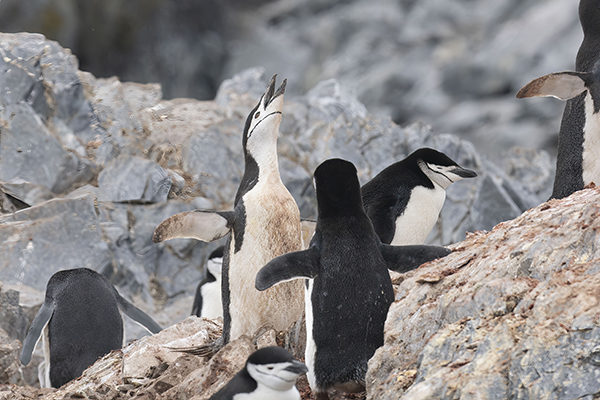
Excitement was building on board as, after not seeing land for several days we were within striking distance of our first landfall and zodiac landings on South Shetland where we'd also encounter our first penguin colonies.