Pages

12 Dec 2018

Royalty visits the island of the druids.

Earlier this year a long staying American Royal Tern that had been on the Channel Islands shifted temporarily to the south coast. Royal tern is currently split into two subspecies - African and American. The Channel island bird had an American banding association ring on its right leg as did the Pagham bird so the assumption is they're the same bird. I wasn't to bothered as I'd seen) the N Wales bird in 2009 that I refound at Black Rock Sands, Porthmadog.
See crap photo below:
Many of the local N Wales and Cheshire / Wirral birders got to see this bird before it got dark but unfortunately it had gone the next morning only to reappear a few weeks later at Llandudno for a few short hours.

The feeling was at the time that this may have been of the African subspecies as there are subtle differences in structure  and also the bill size  / colouration.

However, the IOC, whose taxonomy the BBRC have adopted, have recommended Royal Tern be split into two species.

Cue wild-spread interest when twitter lit up to say a Royal Tern ringed on the right leg had turned up on Anglesey. Less than an hour from the office! With no time to get there on the day it was found (Monday) a Hilbre team made a tentative plan to travel on the Tuesday picking me up via Mold where my car was going in for a service.

News duly broke early that the bird was still there and the twitch was on. We made the journey in good time to find the bird had temporarily disappeared round a headland. After waiting for awhile  I decided to walk round the headland only to get a phone call about 30 minutes later to say it was back in the bay!

For the next few hours it foraged from bay to bay occasionally settling briefly and providing great views to the assembled throng of appreciative birders.


Photos courtesy of Malc Curtin.

The assumption is of course that this is probably the same bird that was in the Channel Islands as its ringed on the right leg. Apparently there is a paper in the offing that will give pointers to the separation of the two sub species in the field so it could be the previous N Wales bird could eventually be identified as African!

An excellent short twitch and many thanks to the Stig who drove and Mr Stato who's lovely wife provided the nourishment in the for mof home baked muffins and cookies!

10 Dec 2018

Unexpected item in the feeding area!

Not much happening recently bird wise due to work commitments. I managed to catch a couple of Redwing and Blackbirds in the garden before they demolished all the holly berries and moved on to the next food source.


A real garden 'mega' though this weekend when I looked out to se a juvenile Moorhen beneath the feeders. The nearest pond is several hundred metres away!


17 Nov 2018

Eider, Hilbre

I forgot about these photo's of Eider on Hilbre! One of the features this year on Hilbre has been the number of Eider loafing around the island. On quiet days sitting in the Obs we specualte as to whether these birds are from the population at Walney in Cumbria or Puffin Island, Anglesey. Puffin Island is probably closer and the population there is increasing.

These photos were taken back in September and show a sub adult male and a juvenile - probably a male from the whit beginning to show through on the breast although that may just be misplaced feathers.

Wherever they come from they're always a nice addition to the Hilbre day list!


9 Nov 2018

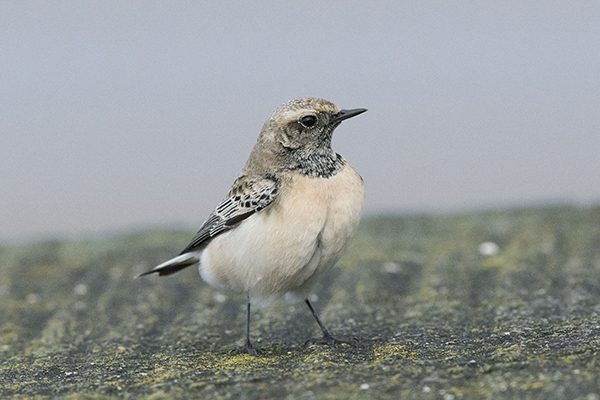
Pied Wheatear - a potential first for Cheshire & Wirral

When Richard Ashford took some photos of a late Wheatear at on the sea defences at  Meols on Monday and Tuesday this week and forwarded them to Richard Smith little did he know what he'd found. Richard circulated them and Steve's  immediate reaction was 'shit, thats no Northern'

Other photos showing the tail pattern confirmed it as potentially Cheshire and Wirrals first Pied Wheatear.  Potentially as one of the Hilbre Bird Observatory founder members recalls finding one with the late John Gittins but it was never submitted.

Steve put the news out on the local WhatsApps group Tuesday night and cue much angst amongst the Wirral and Cheshire birding fraternity. A major rarity on our doorstep for two days and nobody had realised. Would it be there the next day? With a trip to Somerset later on the Wednesday I set the alarm for 6 am and aimed to get to site just after 1st light.

Tuesday night was wet and miserable so it was hoped the bird would have roosted and still be there in the morning. Luckily it was and Al C, who lives within a mealworms throw of the site, put the news out the bird was still there as I was driving up the Wirral peninsula.

Expecting the bird to have moved further along the coast, perhaps into the dunes or pony paddocks, I put my wellies on only to pull up behind a line of other cars and have the Pied Wheatear land on the seawall next to me. That was the pattern for the next hour or so. The bird was completely unconcerned by its growing crowd of admirers, dog walkers, cyclists or parents walking their children to school. It would flit over the sea defences to reappear a few metres away. As the light improved slightly so my photos got slightly better.


It was feeding well on small black flies that were probably hatching from the rottens seaweed on the beach just below the sea defences. It was also seen catching wasps.

My only concern when I viewed the photos was that the tail pattern (see out of focus shot below) was closer to the illustration of Eastern Black-eared Wheatear in Collins but I think everyone is happy that it is a Pied Wheatear and looking closely you can see the scaly mantle feathers.

Amazingly the Wirral hasn't had a Desert Wheatear! Now we've had something even rarer. Over the years I've seen Desert Wheatear on the beach at Crosby, on the beach at Rhyl and an adult spring male at Irlam, Greater Manchester. All around us but not yet here. Surely that must be a good bet soon.


23 Oct 2018

Catbird video

I've just editied a short video I took of the Lands End Gray Catbird taken last Wednesday. Brilliant as the bird was in cover when I took it but I'm pleased to have got anything at all seeing as I'm pretty crap at hand holding the phone to the scope.


As of today (Tuesday 23rd October) the bird is still present and has probably been the bird of the year so far.

A garden regular

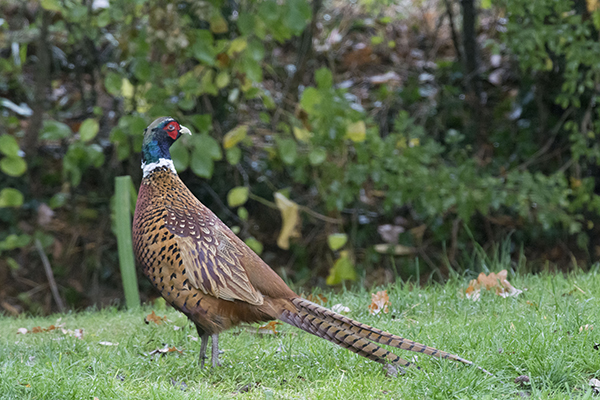
This male pheasant has been a regular garden visitor for the last two autumns we've been in the house. It obviously knows when the pheasant shooting season starts (1st October) and 'retires' to our garden to avoid getting shot. Pheasants aren't released on the farmland near us but the farmer does allow rough shooting on his land so this bird knows where it'll be safe.


Although introduced and not truly wild its still a stunning bird to see regularly in the garden.

17 Oct 2018

Not a Saturday Catbird.

When a Gray Catbird turned up on Anglesey on Thursday4th October 2001 I was the other side of the World trying to cope with the searing humidity of wearing a suit to meetings in Malaysia. The bird was mired in a certain amount of controversy as it was typically elusive and there were allegations and counter allegations as some people claimed to have seen it on the Saturday when the majority didn't. A good friend, now sadly deceased and greatly missed, saw the bird on the Saturday and had to put up with years of malcontent form the disgruntled majority who didn't see it on that day claiming the lucky few had seen a Blackcap.

Roll forward 2018 and with an abortive attempt for a first for Britain on the Monday news broke late of a 2nd Gray Catbird near Lands End in Cornwall.  Family comes first and a recent bereavement meant I couldn't make the journey down at first light on Tuesday. Luckily I had the offer of a lift to get there and back on Wednesday (today) so I quickly decided it was worth a punt.

Meeting up at 00.45 with my elective chauffeur we made good progress and arrived on site in darkness around 06.45. One of the prospects I relish about these twitches is meeting up with old friends I hadn't seen for years but the talking had to come later. More importantly was the Catbird still here?

A tense 45 minutes ensued as it got lighter before Mark Sutton shouted he'd got it perched up in blackthorn around 60 m away. Everyone got on it before the bird flew towards us and landed in scrub willows around 15 m in front of us. From then onwards it showed exceptionally well on occasions before diving into thick cover and reappearing further down the line of assembled birders.

Great. This skulker was showing really well and I hadn't bothered bringing my camera as I was expecting brief views only and the weather forecast said it was going to rain whereas the bird performed in sunshine! Arse, as our good friend would have said.

I'd even left the digi-scoping adaptor in the boot of the chauffeur driven limousine and had to rely on hand holding my phone to the 'scope to get any record shots.


A great day out and for once the motorways were relatively painless. Many thanks to my anonymous chauffeur for doing all the driving.

Now maybe those sourpusses who've been chunnering on about the Saturday Catbird since 2001 can finally lay their demons to rest.