Pages

4 Jun 2022

Eleonora's Falcon

Eleonora's Falcon is one of those birds that, when the almost annual report of  a 'possible' comes through on the rare bird news groups, most birders roll their eyes. Theres been a grand total of 7 UK records - all since 1977 and none have been twitchable. 

Luckily a photo posted on Twitter as a Hobby being attacked by a crow at Sandwich Bay was soon reidentified as an Eleonora's Falcon. Maybe this one would stick? With a number of people out searching the bird was relocated the day we were leaving for a holiday with our two youngest granddaughters. Not an ideal scenario. 

As the days passed and it became apparent that the bird was settled and had got into a routine I dared to hope it would still be there when we returned.  It was and after agreeing with a friend, who'd also just got back off holiday, we met up with two of his mates and left for Kent at 3 am in the morning.

An uneventful journey sped by as we chatted about previous twitches we'd been on and birds we'd seen. As the time approached  7 am we went silent. News that the bird was still present had been coming out around this time so we waited anxiously on positive news. Sure enough the news came through just after the magic hour that the Eleonora's Falcon was roosting on the north side of its favoured wood.

By the time we'd parked up and walked round to the site it had moved to a willow where it sat partially obscured for the next hour and a half. The weather was beautiful. Not a cloud in the sky and getting hotter by the minute. A heat haze made viewing anything at distance an issue. A female Red-footed Falcon had also been present on site and this showed distantly on wires as it made sallies to hunt before returning to perch. 
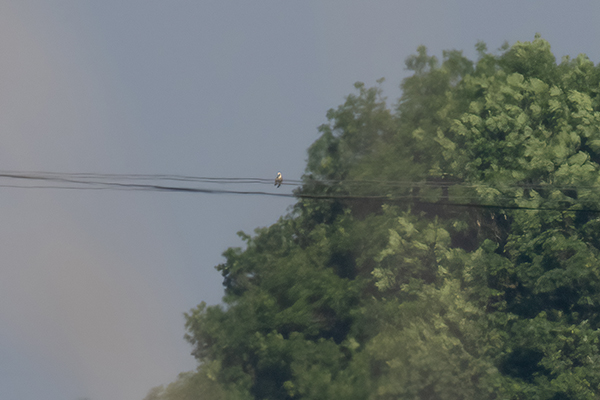
1st summer Red-footed Falcon.

With several Hobbies hunting and calling Cuckoos it was a fantastic wildlife experience. Seemingly the conditions were now right as the Eleonora's suddenly decided to start hunting and we watched as this superb aerial hunter caught and ate dragonflies on the wing. At times it soared almost out of site before twisting and chasing down another unfortunate dragonfly.


We watched the bird drift away past the field where we'd parked the car so decided to head back and see if we could see it from there. When we arrived the bird had flown even further away and was very distant. It came back later in the afternoon after we'd gone and perched again in its favoured willow where, luckily, Cliff, who'd had a tortuous drive back from Shetland where he'd spent the week, got this photo when he arrived early evening.


Eleonora's Falcon was named in 1840 by the zoologist Giuseppe Gene after Eleonora of Arborea (c1347 - 1404) and is the Sardinian Islands greatest heroine. She led her troops in battle  but was a politician and law maker responsible for the Carta di Logu. She also exhibited foresight by passing laws to prohibit the taking of hawks and falcons in her dominion and to protect their nests. 

It exists as two colour morphs  - a dark morph and a light morph (this bird). It's a long distance migrant that breeds on Mediterranean Islands but winters in Madagascar. Two thirds of the worlds population of 
the worlds population breeds on Greek Islands. All the UK records have been spring / summer overshoots apart from a freshly dead bird found in October in Yorkshire in 1981.

As well as the stsr attraction I also saw another new species down at Worth Marshes. Marsh Frog! This species isn't native but was introduced into Kent in the 1930's but have become well established. Why it was introduced from the Mediterranean I can't seem to find out.


A great day out and thanks to Neill for driving.  Hopefully the Eleonora's Falcon will summer here now and give many others the unique oppurtunity to catch up with this beautiful bird of prey in the UK


25 May 2022

Quail on my local patch

I've always kept a local patch list. When I lived at home in Suffolk my local patch was fairly extensive and I'd spend all day walking around the local woods and along the streams and river's surrounding where we lived. As I've got older my patch has shrunk and now I tend to work a loop around of Cheshire home which, according to information put up by the Parish Council on the village notice board during Covid lockdowns, is exactly 6,000 steps! I try to do this loop at least 5 days a week. 

The patch is mainly improved pasture with a lot of old clay pits which now form ponds. Some of the fields get very wet and flood in winter which can be good for the occasional wader and regular small groups of wildfowl. There is also a fair bit of land turned over to arable with potato's, wheat, barley, maize and oilseed rape all being grown. 

It gets a bit dispiriting sometimes counting the same 4 Chiffchaffs or 6 singing Blackcaps but just occasionally an exciting new bird makes it all worth while. Recently I found the patches first ever singing male Reed Bunting.  Normally they've been fly overs or occasional visitors (including last years memorable garden 1st caught and ringed - see here. The hedges around here tend to get flailed every year but the few ones that are allowed to grow still host a few pairs of breeding Yellowhammers.

With large numbers of Spotted Flycatchers being reported on the north Wirral coast recently I thought there may be a chance of one dropping in locally. They used to breed ina garden a few few hundred metres from home but sadly disappeared years before we actually moved into the village.  

Walking the single track lane with nicely overgrown hedges I'd already heard two Yellowhammers and the Reedbunting when I was suddenly stopped in my tracks. Surely that was a Quail? A few minutes silence and there it was a gain. A distant ' wet my lips' It was quite breezy and  I still wasn't sure if my ears were deceiving me. Ringing Mark Payne, who's doing a local "Big Year" I carried on with my walk. Mark rang me back to say he was on the way and as I'd nearly reached home he'd pick me up. Sure enough almost as soon as we'd got out the car the Quail called from its favoured field of barley. For some reason Quail really like barley and I've spent hours over the years walking local routes with adjacent barley fields hoping to find a Quail!

The next day was a bit calmer and I again walked the village loop. This time the Quail was in a neighbouring field and I managed to get a couple of recordings on my phone.


A few other people 'twitched' my Quail but on Monday there was no sign of it early morning. Knowing someone else I knew was going to try for it later for his Cheshire year list I said I'd go out again when the temperature had warmed up a bit. 

I didn't fancy the walk again so decided to go on my bike. Within two minutes of leaving the house I nearly fell off the bike when the Quail called right alongside the lane in a different field.


I realised the bird had probably moved though three different barley fields and the actual straight line distances weren't so big between the records.

A great local record and one that brings up the local patch list to 132 species. 


9 May 2022

Leucorhoa, leucorhoa!

 One of the features of late spring migration on Hilbre is the passage of Greenland Wheatears (Oeananthe oenanthe leucorhoa) These aren't a separate species but a race of our commoner Northern Wheatears (Oeananthe oenanthe). They're bigger and bulkier and tend to migrate later than Northern Wheatears. They use Hilbre as a stop off point and replenish their fat reserves before continuing their migration across the Atlantic to either Iceland, Arctic Canada or Greenland to breed. 

Because of covid  I'd not been able to get to Hilbre for almost two years but finally with the removal of restrictions I've been managing to get across a bit this year. I was lucky enough to retrap a female Greenland Wheatear on several occasions over the last week since she was ringed.

She was ringed on 27th April and weighed 31.7 g, on 29th she weighed 32.8 g and on the 4th may she weighed 35.7 g! Fat deposits are the birds equivalent of rocket fuel! 


By contrast this beautiful male was ringed yesterday and weighed a whoppping 40.2 g! He'll be on his way very soon.
This bird was aged as a second calendar year male (Euring 5) becuase of the contrast between the browner coverts and dark loral mask. In a full adult these would be the same colour. 

Whinchat are another migratory species that sometimes end up on Hilbre in spring with the occasional one caught and ringed. There was a single male on the morning I arrived and this promptly disappeared but then a pair appeared after the hight tide. 


As well as reacquainting my self with the Wheatears I also got to ring whats probably my first Sedge Warbler since 2019! Great little birds and one I used t o be very familiar with when I first started ringing at Wicken Fen.

Most of the waders are now migrating north to breed but there are still a few hanging around the island including a fine summer plumaged Purple Sandpipier. Not a plumage we get to see very often as most of the Purple Sandpipers don't linger into May.

Likewise with the Dunlin. A flock roosted art the north end and there were a variety of plumages on show - ranging from almost full summer to still in their drabber winter colours.


Maintenance is an ongoing past time on Hilbre. The winter storm take their toll on the infrastructure and our heligoland traps. The SK heligoland had suffered some damage to the cliff top east side entrance baffle so work started to replace this as it'll help funnel birds flying down the bushes on the east side into the entrance of the trap.


All in all it was a fairly good day. A few nice birds ringed to keep the annual totals ticking over and some essential maintenance started!


1 May 2022

Linnets

A feature of springs on Hilbre are the Linnets. They breed in good numbers on both Hilbre and Middle Eye and last year appears to have been an exceptional breeding season for them. They're a bird associated with music hall songs and a bygone era of trapping wild birds for their singing capabilities. Linnets used to be caught and blinded by sticking needles in their eyes as that somehow encouraged them to sing. They've been immortalised in the music hall song 'My Old Man'

'My old man said follow the van and don't dilly dally on the way' 

'Off went the cart with the home packed in it walked behind with me old cock linnet'

A song about doing a flit from rented accommodation as they couldn't afford the rent and quite common in the late 19th and early 20th century.

Linnets are on the UK red list of species of concern and numbers have dropped dramatically due to changing farming practices and habitat destruction. When I was training to ring at Wicken Fen in the 70's they were still quite common and I got to ring a few. It wasn't until  I started ringing again at Hilbre that I became reacquainted with these beautiful little finches in the hand. I'm lucky to have a few pairs breeding close to where we live and a couple of years ago I caught and ringed several in the garden. See here

Ageing and sexing Linnets is quite straight forward in adult plumage but juveniles can be a bit trickier. This time of year you have to be careful of male Linnets looking very similar to females though. In the hand it can be easier as male Linnets tend to have more white on the outer web of the primaries and this reaches the shaft. On females there is a distinct gap between the shaft and the white.  A male Linnet with a nice red breast is easy to sex! 

Female Linnet wing showing white on outer web of primaries doesn't reach feather shaft


Male linnet open wing. Note extent of white on outer web of primaries compared to female above.

Male Linnet - they're easy in this plumage! 

As with many passerines ageing is on a combination of features and depends on an understanding of moult. During their post juvenile moult Linnets replsce almost all their greater coverts and sometimes all of them . The outer ones are genreally not replaced until the following year after fledging when the bird undertakes its first full post breeding moult. Juvenile type greater coverts have buffish tips and are shorter than the adult type. Checking the alula feathers for a moult limit is also a useful indicator. Tail feathers can also provide a clue with juvenile type tail feathers being more pointed and worn than adult type.


14 Apr 2022

Hilbre - a few more migrants trickling in at last

My last two trips across to Hilbre have started in the dark to get to the island at first light. A few migrants are beginning to pass through with Chiffchaff, Willow Warbler and Blackcap being ringed over the last couple of weeks. Wheatears are also on the move and birds of the Greenland race 'leucora' are starting to arrive.

Chiffchaffs

Willow Warbler

Male Blackcap

Male Wheatear
Although spring is definitely here signs of winter aren't far away. A couple of Purple Sandpipers are still to leave the islands for their arctic breeding grounds and there are still a few Brent Geese hanging on. Snow on the Carnedd hills looking west towards north Wales was a distinct reminder that, at this time of the year, the weather can still be fickle.

One of the features of springs on Hilbre is a small passage of Wrens. Most of the resident birds are ringed during the year but every spring we get a number of 'new' birds passing through. Ringing recoveries as far away as north Lancashire shows these are passage birds. 

Eider were a scarce bird on the Wirral and the first pair bred last year. The long staying female seems to have moved on but theres a smart male hanging around and provided a good photo opportunity as it swam past the north end framed by spray from breaking waves.


The local Meadow Pipits and Rock Pipits are displaying and providing good practice in ageing. As well as photographing birds in the hand they've also provided a few opportunities for photographing in the field. 
Rock Pipit

Meadow Pipit

Rock Pipit

Star bird for me, on my most recent visit, was this female Kestrel.  She's been hanging around the island for awhile and had been ringed previously. From photos I managed to read the ring number but it was caught in a mist net allowing us to confirm the number and the age. Its a 2nd calendar year bird ringed as a nestling on the Wirral in 2021. A very feisty bird that attacked me with both its talons and bill - hence the fish filleting glove! Kestrels are renowned for beign feisty. Sparrowhawks will use their talons on you but Kestrels use all the weapons at their disposal. I know how a vole feels now! 


After the last tow years of lockdowns and the islands being closed to the public by Wirral Borough Council its nice to start getting back to some sense of normality.


12 Apr 2022

Slime moulds

Whilst looking around the garden the other day we spotted this strange looking thing growing on a dead damson tree. Further examination suggested it was a slime mould. Slime moulds were once considered to be a fungus but are now regarded as a protozoa.They have a bizarre lifecycle as they start off with a single cell amoeboid organism that feed on bacteria and fungi. In suitable conditions these individuals coalesce into a plasmodial stage breeding partnership linked by interconnecting strands.

This stage doesn't last long and as the food substrate runs out they start producing spores - usually within a couple of days.

The one in the garden appears to be Reticularia lycoperdon - a first for me! Its also known as False Puffball or Cauliflower slime mould.

The photos below were taken on three consecutive days and by the third day you can see the brown spores developing. Amazing.

Day 1
Day 2

Day 3


4 Apr 2022

Hilbre - in praise of pipits

Meadow Pipits are a very underrated bird. They're little brown jobs that seem to be preyed upon by many of our raptor species. Merlins, Sparrowhawks, Hen harriers and even Peregrines are partial to a Meadow Pipit. They're also fascinating. Breeding on some of our most inhospitable terrain in the hills they'll move down to lower elevations in winter and a large proportion of the population are migratory. 

They're also interesting to ringers as they undergo a partial pre-breeding moult involving the median and lesser coverts an occasionally the inner greater coverts, tertials and central tail feathers. This makes ageing interesting and reliant on a whole suite of characters including an assessment of feather wear.

Hilbre has a small breeding population of Meadow Pipits and we get to ring quite a few each year. Even so it still takes time to get your 'eye in' when catching them in the spring.


In recent years Hilbre has also hosted a small population of Rock Pipits. Again, many dismiss these as 'little brown jobs' but close up the intricacies of the plumage are stunning. They're a much bigger bird than the Meadow Pipit and undergo the same pre-breeding moult (in addition to their post juvenile and post breeding moults). I was lucky ewnoufgh to be able to process two retrap Rock Pipits on my recent trip to Hilbre so was able to examine them closely knowing that they'd already been ringed and aged previously.


As well as the pipits we had a small smattering of migrants on the island with Goldcrest, Robin and male Blackcap being ringed.


Nine Purple Sandpipers were still feeding around the island and roosted over the high tide on the sheltered west side of the island away from the biting easterly wind. Other spring migrants included a male Ring Ouzel that flew up from the south end of the island over our heads and landed on the track before promptly disappearing beneath one of the fences. Despite an intensive search it was only seen once again, in flight, being pursued by the resident male Blackbird. I also got to see my first Wheatear of the spring!