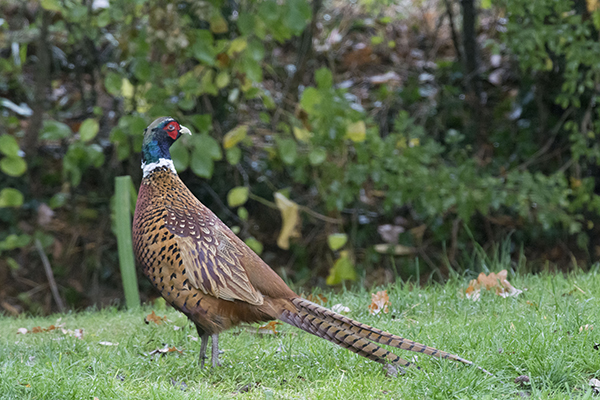
This male pheasant has been a regular garden visitor for the last two autumns we've been in the house. It obviously knows when the pheasant shooting season starts (1st October) and 'retires' to our garden to avoid getting shot. Pheasants aren't released on the farmland near us but the farmer does allow rough shooting on his land so this bird knows where it'll be safe.
Although introduced and not truly wild its still a stunning bird to see regularly in the garden.
23 Oct 2018
17 Oct 2018
Not a Saturday Catbird.
When a Gray Catbird turned up on Anglesey on Thursday4th October 2001 I was the other side of the World trying to cope with the searing humidity of wearing a suit to meetings in Malaysia. The bird was mired in a certain amount of controversy as it was typically elusive and there were allegations and counter allegations as some people claimed to have seen it on the Saturday when the majority didn't. A good friend, now sadly deceased and greatly missed, saw the bird on the Saturday and had to put up with years of malcontent form the disgruntled majority who didn't see it on that day claiming the lucky few had seen a Blackcap.
Roll forward 2018 and with an abortive attempt for a first for Britain on the Monday news broke late of a 2nd Gray Catbird near Lands End in Cornwall. Family comes first and a recent bereavement meant I couldn't make the journey down at first light on Tuesday. Luckily I had the offer of a lift to get there and back on Wednesday (today) so I quickly decided it was worth a punt.
Meeting up at 00.45 with my elective chauffeur we made good progress and arrived on site in darkness around 06.45. One of the prospects I relish about these twitches is meeting up with old friends I hadn't seen for years but the talking had to come later. More importantly was the Catbird still here?
A tense 45 minutes ensued as it got lighter before Mark Sutton shouted he'd got it perched up in blackthorn around 60 m away. Everyone got on it before the bird flew towards us and landed in scrub willows around 15 m in front of us. From then onwards it showed exceptionally well on occasions before diving into thick cover and reappearing further down the line of assembled birders.
Great. This skulker was showing really well and I hadn't bothered bringing my camera as I was expecting brief views only and the weather forecast said it was going to rain whereas the bird performed in sunshine! Arse, as our good friend would have said.
I'd even left the digi-scoping adaptor in the boot of the chauffeur driven limousine and had to rely on hand holding my phone to the 'scope to get any record shots.
A great day out and for once the motorways were relatively painless. Many thanks to my anonymous chauffeur for doing all the driving.
Now maybe those sourpusses who've been chunnering on about the Saturday Catbird since 2001 can finally lay their demons to rest.
Roll forward 2018 and with an abortive attempt for a first for Britain on the Monday news broke late of a 2nd Gray Catbird near Lands End in Cornwall. Family comes first and a recent bereavement meant I couldn't make the journey down at first light on Tuesday. Luckily I had the offer of a lift to get there and back on Wednesday (today) so I quickly decided it was worth a punt.
Meeting up at 00.45 with my elective chauffeur we made good progress and arrived on site in darkness around 06.45. One of the prospects I relish about these twitches is meeting up with old friends I hadn't seen for years but the talking had to come later. More importantly was the Catbird still here?
A tense 45 minutes ensued as it got lighter before Mark Sutton shouted he'd got it perched up in blackthorn around 60 m away. Everyone got on it before the bird flew towards us and landed in scrub willows around 15 m in front of us. From then onwards it showed exceptionally well on occasions before diving into thick cover and reappearing further down the line of assembled birders.
Great. This skulker was showing really well and I hadn't bothered bringing my camera as I was expecting brief views only and the weather forecast said it was going to rain whereas the bird performed in sunshine! Arse, as our good friend would have said.
I'd even left the digi-scoping adaptor in the boot of the chauffeur driven limousine and had to rely on hand holding my phone to the 'scope to get any record shots.
A great day out and for once the motorways were relatively painless. Many thanks to my anonymous chauffeur for doing all the driving.
Now maybe those sourpusses who've been chunnering on about the Saturday Catbird since 2001 can finally lay their demons to rest.
16 Oct 2018
Choughing Nora
A great couple of hours local birding after the disappointment of not being able to get to Fair Isle and dipping the White-rumped Swift in Yorkshire. There've been a few Choughs seen in Cheshire and Wirral over the years but most have been flyovers or very brief stayers. Thank you to whoever reported this bird near Caldy today and thanks for Steve for putting the news out! A Cheshire and Wirral first for many people including me.
A bird was seen and photographed recently on Hilbre but that one had a green colour ring on one leg. This bird is a different individual as its un-ringed.
When the news came out I was at home but 30 minutes later I was yomping the short distance along the beach to where Al & Steve were watching the bird on rocks below just north of the Dee Estuary Sailing Club.
I don't think there'll be any issues getting this through the Cheshire rarities committee.
A bird was seen and photographed recently on Hilbre but that one had a green colour ring on one leg. This bird is a different individual as its un-ringed.
When the news came out I was at home but 30 minutes later I was yomping the short distance along the beach to where Al & Steve were watching the bird on rocks below just north of the Dee Estuary Sailing Club.
24 Sept 2018
A longe overdue trip to Hilbre.
After the seawatching bonanza of the past week when storm Ali graced us with her presence a plan was hatched to spend a day on Hilbre and do a bit of seawatching over the high tide last Sunday. Although the prolonged gale force winds had receded the Met Office was still showing that the wind would gradually increase during the day so with Mark P meting me at my house and picking up Steve on the way through we set off to relieve the early shift of Alan & Colin.
It was great to be back on the island even though the seawatching was bit dismal with only a handful of terns, auks, Kittiwakes and Red-throated Divers to show for our endeavours. A couple of rounds of the heligoland traps resulted in another Robin being ringed as well as a late Chiffchaff.
Other summer migrants were represented by two Wheatears whilst autumn finch passage was represneted by three Goldfinches that spent the high tide feeding on seed heads around the paddocks.
Wader numbers are building up and as usual Oystercatchers are the commonest bird.
The long staying sub-adult male Eider put in an appearance and has been recently joined by a juvenile bird. We've been speculating where these birds originate from. Eider used to be a regular but scarce visitor to the N Wirral coast but recently they've been much commoner. This seems to coincide with a population increase on Puffin Island suggesting they've come from there rather than the colony at Walney. Perhaps the presence off Hilbre of a juvenile Shag as well on Sunday has some relevance as they also breed on Puffin Island and we've had a few ringing recoveries from there.
All in all a bit quiet bird wise but still a great day and it was just nice to be out and about for a change.
It was great to be back on the island even though the seawatching was bit dismal with only a handful of terns, auks, Kittiwakes and Red-throated Divers to show for our endeavours. A couple of rounds of the heligoland traps resulted in another Robin being ringed as well as a late Chiffchaff.
Other summer migrants were represented by two Wheatears whilst autumn finch passage was represneted by three Goldfinches that spent the high tide feeding on seed heads around the paddocks.
Wader numbers are building up and as usual Oystercatchers are the commonest bird.
The long staying sub-adult male Eider put in an appearance and has been recently joined by a juvenile bird. We've been speculating where these birds originate from. Eider used to be a regular but scarce visitor to the N Wirral coast but recently they've been much commoner. This seems to coincide with a population increase on Puffin Island suggesting they've come from there rather than the colony at Walney. Perhaps the presence off Hilbre of a juvenile Shag as well on Sunday has some relevance as they also breed on Puffin Island and we've had a few ringing recoveries from there.
All in all a bit quiet bird wise but still a great day and it was just nice to be out and about for a change.
6 Sept 2018
A bit of garden ringing
We've had good numbers of Greenfinches and Goldfinches in the garden recently - flocks of 30+ for each! With the wind dropping at the weekend I put a mist net up in the garden to ring a few. Interestingly I've ringed quite a few Greenfinches and Goldfinches in our new garden with only a single re-trappped Goldfinches and no Greenfinches.
A lot of the Goldinches are still in full juvenile plumage suggesting the species has had a good breeding season with several broods. Others are more advanced and have almost completed their post juvenile moult.
Many of the Greenfinches have completed their post juvenile moults but some, like this juvenile female below, are still completing theirs - this bird is moulting all its greater coverts.
Great Tits seem to have fared better than Blue Tits locally and I'm catching more juveniles of the larger species. Most have almost completed their post juvenile moults with the majority having replaced their greater coverts already and actively moulting their tertials and tails.
Just as I was packing up a large 2nd calendar year female Sparrowhawk hit the net alongside my head causing an outburst of fairly choice language. It certainly made me jump! Luckily I soon recovered as it certainly wouldn't have stayed caught for long. My 2nd in this garden in the two years we've lived here. I wonder if this is the bird that predated one of our local Little Owls in the garden?
I had a new patch / garden tick at the weekend with a flyover Spotted Redshank heading towards the Dee estuary. The last new patch bird I had was a Sedge Warbler in the spring!
A lot of the Goldinches are still in full juvenile plumage suggesting the species has had a good breeding season with several broods. Others are more advanced and have almost completed their post juvenile moult.
Many of the Greenfinches have completed their post juvenile moults but some, like this juvenile female below, are still completing theirs - this bird is moulting all its greater coverts.
Great Tits seem to have fared better than Blue Tits locally and I'm catching more juveniles of the larger species. Most have almost completed their post juvenile moults with the majority having replaced their greater coverts already and actively moulting their tertials and tails.
Just as I was packing up a large 2nd calendar year female Sparrowhawk hit the net alongside my head causing an outburst of fairly choice language. It certainly made me jump! Luckily I soon recovered as it certainly wouldn't have stayed caught for long. My 2nd in this garden in the two years we've lived here. I wonder if this is the bird that predated one of our local Little Owls in the garden?
I had a new patch / garden tick at the weekend with a flyover Spotted Redshank heading towards the Dee estuary. The last new patch bird I had was a Sedge Warbler in the spring!
3 Sept 2018
Romany of the BBC
One of the biggest influences on my early life as a budding naturalist was the books my father had written by the Rev George Bramwell Evens who broadcast wildlife programmes on the radio as "Romany of the BBC".
See here for more information: here
The stories of his adventures with his spaniel Raq exploring the countryside in his horse drawn romany caravan or 'vardo' absorbed me for hours and I read and re-read these books many times. Sadly, although they are still in my fathers bookcase, they are now in very poor condition having been handled by children and grandchildren many times over the 70-80 years or so since they were published.
The "vardo" was located in his memorial garden in Wilmslow Cheshire for many years but then moved to a permanent home in a museum in Bradford - see here for details on the Romany Society's homepage.
The BBC Radio also did a 'Witness' programme on Romany as a pioneer of wildlife broadcasting and this can be heard here.
I was reminded of all this recently when I visited my parents and saw the books lined up in the bookcase.
See here for more information: here
The stories of his adventures with his spaniel Raq exploring the countryside in his horse drawn romany caravan or 'vardo' absorbed me for hours and I read and re-read these books many times. Sadly, although they are still in my fathers bookcase, they are now in very poor condition having been handled by children and grandchildren many times over the 70-80 years or so since they were published.
The "vardo" was located in his memorial garden in Wilmslow Cheshire for many years but then moved to a permanent home in a museum in Bradford - see here for details on the Romany Society's homepage.
The BBC Radio also did a 'Witness' programme on Romany as a pioneer of wildlife broadcasting and this can be heard here.
I was reminded of all this recently when I visited my parents and saw the books lined up in the bookcase.
21 Aug 2018
Bonepartes Gull, Hilbre.
Whilst I was away on Nan Ron Tim Kinch found an adult Bonepartes Gull at Hoylake. The last one I saw in Cheshire was at Inner marsh Farm RSPB in 2004. Present for only one evening it was a Cheshire and Wirral first for many people. I wasn't to worried about missing the Hoylake bird but as the return date from Nan Ron got closer I began to hope it would stay - they're always a good bird to see. Even better was the news Chris Williams (Hilbre Chairman) had found it in the gutter off the east side of Hilbre - a first for Hilbre!
All we need now is a Franklins on the Wirral and we'll have the set of small N American vagrant gulls.
Luckily the bird was still present on Saturday morning and any plans I'd made about sorting out all my camping gear and unpacking the car went further down the priority list as plans were made for a quick visit to try and see this fantastic addition to the Hilbre rare bird list. Even better, Andrea was staying over at the Obs and had put the news out early and she put me straight on the bird when I arrived. It was always a bit distant to get more than record shots but it showed continuously.
All we need now is a Franklins on the Wirral and we'll have the set of small N American vagrant gulls.
Subscribe to:
Posts
(
Atom
)