Pages

22 Apr 2019

Huffin & Puffin on Hilbre, no G

We've had an excellent few weeks on Hilbre and spring migration has started in earnest. This year I've been able to get over more often and have been present on some really excellent days!

Highlights over the last few weeks have included my first ever Hilbre and Wirral / Cheshire Puffin that appeared off the NE side on a misty morning. Although distant the sea was flat calm so the viewing was quite good. It was on show for about 15 minutes before flying northwards into the mist.


The same day fin ished with the discovery of a colour ringed Oystercatcher as the tide fell and the birds left their roost on Middle Eye. Some detective work and help from Richard Du Feu put me in contact with a Norwegian ringing scheme and the results came back within minutes! Another good 'control' for Hilbre.

Oystercatchers colour ringing in Norway (3)
Last CR-Code Green ring with white Code: T231 LBM;RBGW(T231)
Ringing Centre Stavanger Museum (Norway) Ring number 5195589
Species Eurasian Oystercatcher  Haematopus ostralegus Map Map
Date
Place
Coordinates
Days
Distance
Direction
Upload picture
19.07 2017Observers pull  Additional information 
 Colour mark added
Lynghøyen, Mjåtveit, Meland, Hordaland, Norway
60°30'57"N 005°13'41"E
-----
-----
---
Upload picture
06.08 2017Observers Additional information 
 Colour mark already present
Lynghøyen, Mjåtveit, Meland, Hordaland, Norway
60°30'57"N 005°13'41"E
18
0
 Map
Upload picture
16.04 2019Observers Colour mark already present
Hilbre Island, Cheshire, Great Britain
53°38'22"N 003°22'54"E
636
773
 Map


Short-eared Owls are on the move and the Chairman and I arrived one evening for an over night stay to find Paul Slater had found an owl that had been showing exceptionally well just outside the Obs before we arrived. A quick search of the island as dusk fell revealed it at the north end of the island.


A fabulous bird and a fabulous sunset.


A week later another Shortie was disturbed in bracken at the north end of Hilbre and flew towards Red Rocks being pursued by angry Herring Gulls.


Over the last week or so good numbers of pipits and flava wagtails have been passing over the island but the misty Puffin day also resulted in a few being grounded and spending the morning buzzing round the various paddocks and gardens - including these two that turned up in the Obs garden!


Another recent visit coincided with a fall of migrants and 82 birds were ringed. Mainly Willow Warblers but there were good numbers of Blackcaps and Chiffchaffs as well. The day coincided with Hilbre's first Ring Ouzel of the spring. As is common with these birds on Hilbre it hung around for most of the day and was eventually caught in one of the heligoland traps. This particular bird was really scaly underneath and caused some discussion over its potential origin.


The Ring Ouzel wasn't the only highlight of the day. Two Grasshopper Warblers, a fine male Redstart  and a Hilbre scarcity in the form of a Sedge Warbler was also ringed.


If the spring carries on like this I'll have to consider making Hilbre my local patch for Patchwork Challenge 2020 rather than the area around my usual one! At the moment I'm on 80 species for Hilbre and 80 for my local patch / garden!


16 Apr 2019

Migrants on Hilbre

Now I've got a bit more time on my hands its been nice to be able to visit Hilbre more often. As always there is plenty of maintenance work to do to the observatory building, heligoland traps and various gates and fences after the winter period. The running and maintenance of the observatory relies upon a small group of dedicated volunteers - whether its ringing, recording or maintenance the work involved in running an accredited observatory is never ending!

Spring migration is now well underway and an early morning trip last week with the Chairman resulted in a few birds being caught and ringed in the newly repaired heligoland traps (well, they're nearly finished!). My first Wheatears of the year passed through pausing only for a quick photo at the south end.


The first Willow Warbler of the spring was trapped and ringed along with a couple of Chiffchaff which made for a nice comparison between these two species.

 Chiffchaff above, Willow Warbler below

We've already had a controlled Chiffchaff this year and it'll be interesting to see haw many other controls we get this year.

10 Apr 2019

Med Gulls.

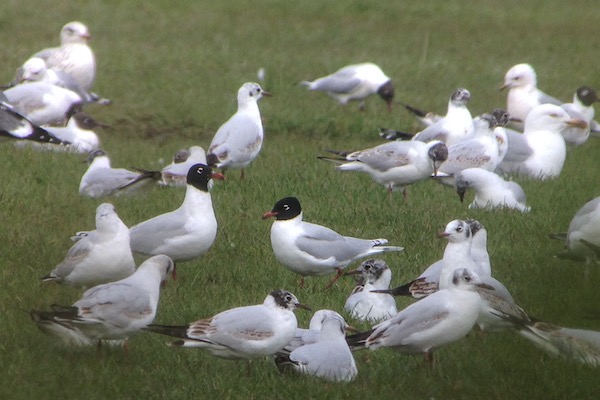
One of the downsides of leaving in a rural area is the smell when the farmer decides to spread slurry on his fields. The window stay firmly shut! On the positiver side though the freshly sprayed fields attract good numbers of gulls and for the past week we've had up to a thousand birds - Black-headed, Common, Lesser Black-backed, Herring and, best of all, Mediterranean Gulls. Still a scarce bird in Cheshire I've managed to see one from the house in all the three springs we've been here.

Checking the gull flock there was initially no sign but I picked one up on call circling round and the next day there were three birds in the flock. Two (a second summer and an adult bird) were obviously paired up whilst the third kept its distance.

Great to see them locally on my patch and even better, from the garden!


The history of this striking gull in the UK is interesting:

The species was formerly a great rarity in Britain with only four or five records before 1940 and the BBRC accepted ten records in 1958, its first year of adjudicating rare birds, but ceased to consider records after 1962. Since then, there has been a rapid increase in the number of records and breeding was confirmed for the first time in Hampshire in 1968. There has been a slow and steady increase in the breeding population since then and between 90 and 104 pairs bred in 2001, the majority in southern England. Events in Britain have mirrored those in Europe and it is likely that the breeding population will continue to increase over the coming years; similar events occurred in France where the breeding population increased from over 100 pairs in 1991 to nearly 1,400 pairs by 1998. The wintering population of Britain is put at over 1,200 birds with over 100 in Ireland. 

Although not a rarity, a summer-plumaged Mediterranean Gull is a match in looks for any of the rare gulls to occur in Britain and Ireland. Despite increasing numbers, away from the south coast the species is scarce enough to make finding a 'Med Gull' in your local gull flock or gull roost a notable event. 
Globally, the distribution of this striking gull is restricted to a few localities in Europe, most particularly in the northern part of the Black Sea, where 245,000 pairs breed in the Ukraine. Elsewhere, it has a fragmented distribution across Europe, with the northwestern limit in Britain and Ireland. The world population is put at between 120,000 and 300,000 pairs, 99% of which are in the former USSR. The main wintering area is in the Mediterranean where up to 700,000 winter, most in the southern Mediterranean. Smaller numbers can be found in western and northwest Europe to southern Scandinavia. Ringing studies have highlighted the use of the large river systems to facilitate movement.
As with other gulls, colour-ringing is starting to provide an interesting picture of the movements of birds throughout Europe. The Migration Atlasreported the origins of some of the birds present in Britain and Ireland where 11 were from The Netherlands, five from Germany, three from Hungary and one from the former Yugoslavia.
(Birdguides).

With breeding or attempted breeding by a small number of birds over the last few years in Cheshire it looks like these birds will feature more regularly in any large flock of gulls.

A number of colour ringed birds have been recorded in consecutive winters on the N Wirral Coast and the first Mediterranean Gull for Cheshire and Wirral was recorded as recently as 1967 and from then in every subsequent year.


3 Apr 2019

Hilbre's Brent Geese

Hilbre is well known for its Brent Goose flock in the winter and rightly so. They are beautiful little geese and make incredible migrations to winter on our estuaries.  Two races are commonly seen in the UK. The dark- bellied race (bernicla) mainly winters on the east and south east coasts and originates in Russia whilst the pale-bellied race (hrota) originates from Svalbard and Greenland and traditionally winters in Ireland and northern UK. Brent Geese are amber listed under the birds of conservation concern and there has been a huge effort in colour ringing birds to track them to and from their breeding and wintering grounds. We have had a number of colour ringed Brent Geese on Hilbre - some returning for several years and travelling all the way from Arctic Canada.

Historically Hilbre always hosted a small number of wintering Dark-bellied Brent Geese a d they still occur  in small numbers. However since the mid 1990's small numbers of Pale-bellied Brents started appearing and the wintering flock now exceeds 3-400 birds regularly. As with other species of goose they travel in family parties and the success of the breeding season can easily be measured by counting the numbers of juveniles in the family parties.

This year we've had a small number of Dark-bellied birds in the flock and some of the flock has started spending the tide feeding on the edges of West Kirby Marine Lake (WKML) where they can provide incredible views if you stay in your car.

Recently I used the Landrover as a photogrpahic hide to get some compassion shots between the tow races. Seeing the interaction between family groups and hearing their gutteral 'hrot' call takes me back to my childhood and seeing my first ever Brent -geese wintering on Mersea Island, Essex.

 Pale-bellied Brent Goose, Hilbre. March 2019
 Dark-bellied Brent Goose, WKML, March 2019
 Juvenile Dark-bellied brent Goose (centre foreground with 'scaly' mantle feathers), Hilbre, March 2019
Adult Dark-bellied Brent Goose, WKML March 2019

Pale-bellied Brent Geese, WKML, March 2019
Adult Pale-bellied Brent (middle) with two juveniles, Hilbre, March 2014

For more information on Brent Geese studies see the Website of the Irish Brent Goose Research Group here

29 Mar 2019

Canon netting at Altcar

Following on from our two successful canon netting trips last year targeting Knot and Grey Plover, as part of a long term study into these species moments and decline, we went back again on the 22nd March this year. Once again the plan was to catch , ring and colour flag as many Knot and Grey Plover as we could.

A big tram assembled early at the Altcar military base gatehouse and after signing in we set off in convoy through the base and down to the foreshore where a brisk onshore breeze was blowing as the tide began to rise. Three nets were set with cables being run to a base camp further back in the dunes before we headed back to the vehicles to meet up wit ha few late arrivals, grab some food and change into warm clothes and waders!

With time pressing the main body of the ringing team set off to base camp to sit it out until such a time that the spotters told us to fire the canons at which point we'd make our way to the net and lift it up the beach out of the water and cover the birds with hessian sacking to keep them calm before extracting them and placing them into safe and warm holding cages before ringing and processing. That was the plan anyway! The best laid plans can always go awry.

Steve kept us informed by radio and as the tide rose lots of birds arrived in the catching area. Anticipation was high and the message was received to arm the firing box when suddenly we heard the noise of hundreds of waders wings beating the air - a Peregrine had flown straight down the beach and spooked all the birds which promptly flew off!

A decisions was quickly made to dash out and reset the nets higher up the beach as quickly as possible to try and make a a catch on the falling tide. At least it wasn't raining as this entailed another long wait in our dune hideaway. Once again Steve kept us informed by radio  - a few birds retuned and the signal was given to arm the firing box..........and fire! Success.

Not a huge catch but successful none the less and with so few Grey plover ringed annually in the UK a catch of 71 Grey Plover of which 65 were new birds and 6 re-traps from last year.

Totals were as follows (From Richard Du Feu)

BAR-TAILED GODWIT - 1 adult, now colour ringed
KNOT - 16.  1 retrap from 22/09/2017. All adults
DUNLIN 7.  1 control probably from mid-Wales (All adults)
SANDERLING- 1 control from Kinmel bay (Adult)
GREY PLOVER - 71.  2 aged 5, the remainder all adults

Grey Plover are fabulous birds ( I remember seeing my 1st ones on Mersea Island in Essex in the late 60's as a kid when we lived down there) and it was a good opportunity to look at the moult in these birds. Grey Plover have curious moult and many arrest their moult during the winter - see paper here:https://www.tandfonline.com/doi/pdf/10.1080/00063657609476512

Most of the birds were adults but there were two young birds hatched last calendar year (Euring 5). These are identified by the gold spangles in the plumage - very reminiscent of an American Golden Plover.


 Juvenile Grey Plover open wing and head shot below. The gold spangles are very noticeable in the head.

Compare this with the adult below:


The catch included fewer Knot than we'd hoped but the ones we caught were duly ringed, flagged and processed. Previous sightings from this flagging project have been incredible and it is hoped the data collected can assist in the future conservation of this declining species. For more information on declining wader populations see Graham Appleton's 'Wadertales' blog here.

A single Bar-tailed Godwit was also colour flagged.


Last year we did several and incredibly one turned up on Hilbre a few days later.


Ultimately a successful day but a very long one! After setting the alar at 05.30 I eventually got home around 17.00 dirty, tired but happy and ready for a beer! 

24 Mar 2019

The value of ponds

We get an amazing amount of wildfowl on the pond opposite the house - despite the local farmers efforts to fill part of it in and deter them (he reckons they pass on worms to his sheep but I reckon its just bad husbandry as the animals don't have access to clean drinking water apart from the pond which now contains the remains of at least two dead sheep....).

The numbers aren't as high as last year when we had torrential rain meaning the field flooded but in this short video there are Teal, Canada Geese, Shoveller, Mallard, Heron & Coot.


The Heron is hunting Great-crested Newts. Another reason to value this pond. Now if only I could acquire the field........

Everyone looks at WeBs counts on large local watercourses but the value of the smaller water courses, such as this pond, are overlooked. When the numbers are combined these small ponds hold a significant number of wildfowl.

21 Mar 2019

Ghost Crab

On our recent Caribbean  cruise we spent a number of days lounging ashore on the beach! A great opportunity for me to catch up with the local Ghost Crabs.

These scavengers burrow in the sand above the tidal zone and scuttle away from you and into their holes if they feel threatened.


Their 'foot' prints were everywhere and you could easily find their burrows by following the trails. Amazing creatures.