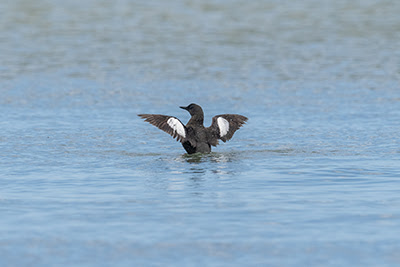
We moved to Suffolk on 11th December 1972 when I was 11 years old. Dads old Rover 90 was full to the gunwales. Four kids along the bench seat in the back. Bonzo, my black Labrador, at my feet and a tank full of goldfish on my knee. Suffolk was an ideal place for me to live as a budding young birder. A stream ran through the hamlet we'd moved to and Kingfishers nested along its bank. Pike lurked in some of the deeper pools and it was alive with Minnows and Sticklebacks. We had Marsh and Willow Tits visiting the garden, Nightingales in the local woods (Linneage Woods) and a pair of Barn Owls in a derelict barn. Lesser -spotted Woodpeckers were still common. Fallow Deer were often see from my bedroom window. It was here that my interest in birds was ignited into a real passion. All my free time was spent out birding with my old Prinz 8 x 32 binoculars given to me as a Christmas present several years earlier by my parents.
It wasn't until I went to high school in Sudbury that my birding wings metaphorically spread. I'd got a weekend job at a local boarding kennels - walking dogs, cleaning pens, feeding them and generally looking after the owners other animals. I found a beautiful male Kestrel dead in their chicken run and took it to school to show my Biology teacher. The Kestrel had dived in after some chicks and somehow broken its neck. He introduced me to Nick who was our senior lab technician and had trained at the Royal Veterinary College in London. Nick arranged for a taxidermist mate of his from the veterinary school to stuff the Kestrel for me and from then on he became one of my most influential birding mentors. With him, his wife Gwen and one of his local mates (RSPB warden Dave Woods) along with local birder Tony Butcher they took me everywhere!
One of our first trips was to Minsmere RSPB. About an hour away in Nicks Citroen Diane. At that time there were only three Marsh Harriers in the whole of the UK. A single male and two females. Hard to believe now when they're so widespread. The only place Avocets bred in the UK was Minsmere and Havergate Island. Bitterns were still extremely rare and only found at a few sites along the east coast. Bearded Tits had just started recolonising the area. I was in ornithological heaven.
Nick ran the school bird club held in the biology lab weekly at lunch time. Minsmere RSPB hosted an inter-schools bird identification competition and we entered a team. Binoculars were not required, although a few of us had them, and we had to each identify 10 species pointed out by one of the assistant wardens. The prize was a copy of The Popular Handbook of British Birds by P.A.D Hollom. We won with my friend Terry Girling and I both getting 100% scores. Many years later Nick sent me the photo below of the winning team. I was fourteen and wearing one of my Dads old shirts. Terry Girling is to my left and I think the photo was taken around 1975 when I was 14. Terry later went on to be a vet and we're still in contact......... occasionally!

By now I was realising the limitations of the old Prinz and sold my stamp collection to buy a new pair of 10 x 50 Swifts. At that time Swift's were the binocular to own along with the Zeiss Jena Jenoptem. Nick had a pair of Swift Audubons and looking through those was a revelation.
Tony Butcher lived in Sudbury and was a well known local twitcher and birder. I think at one point he was Suffolk county recorder. During the 70's Buzzard was extremely rare in Suffolk and Rough-legged Buzzard was the default bird in winter. I'd been used to seeing Buzzards at my grandparents place on Dartmoor so when I found one soaring over our local woods it caused a minor twitch. Tony was convinced it would be a Rough-legged Buzzard when he turned up to take a look.
What is now RSPB Lakenheath Fen was carrot fields with several plantations of poplars which were grown to make match sticks. It was colonised in the late 60's by Golden Orioles and remained their UK stronghold until gradually dying out in 2009. At the peak the population in the UK was 25 pairs with Lakenheath Fen being the best place to see them. From what I understand there is a species of caterpillar that feeds on these trees but only until they reach a certain age. Since the matchstick industry collapsed new plantations weren't planted and the older trees didn't host the caterpillars which were the major food source for the Orioles.
Understandably I was keen to see these avian jewels and when Nick invited me to go with him and Tony I jumped at the chance. I can't remember much about the birds but do remember the awful smell from the nearby maggot factory where we stopped for breakfast!
Until their demise I visited the area several times to see Golden Oriole and below is a photo I took of one in 2006 when I last visited with a friend who needed it as a lifer. By that time there was a single pair.

Golden Oriole is on my Cheshire list courtesy of a bird at Moore nature Reserve in May 2005. My last Golden Oriole was one we found on Fair Isle in 2024. See here for that story.